American Spotlight
Route 66 Centenial 1926-2026
Route 66 isn't just a highway: it's a symbol. Flash the iconic "Route 66" shield to almost anyone, and they'll picture neon motel signs, roadside diners, big skies, and that unmistakable feeling that you're driving through the story of America. With nearly a century of history and an endless string of landscapes and landmarks, Route 66 has earned its reputation as the country's quintessential road. That's why we're paying tribute with a collection of fun, surprising, and downright memorable Route 66 facts. Ready to hit the road? Let's dive in.
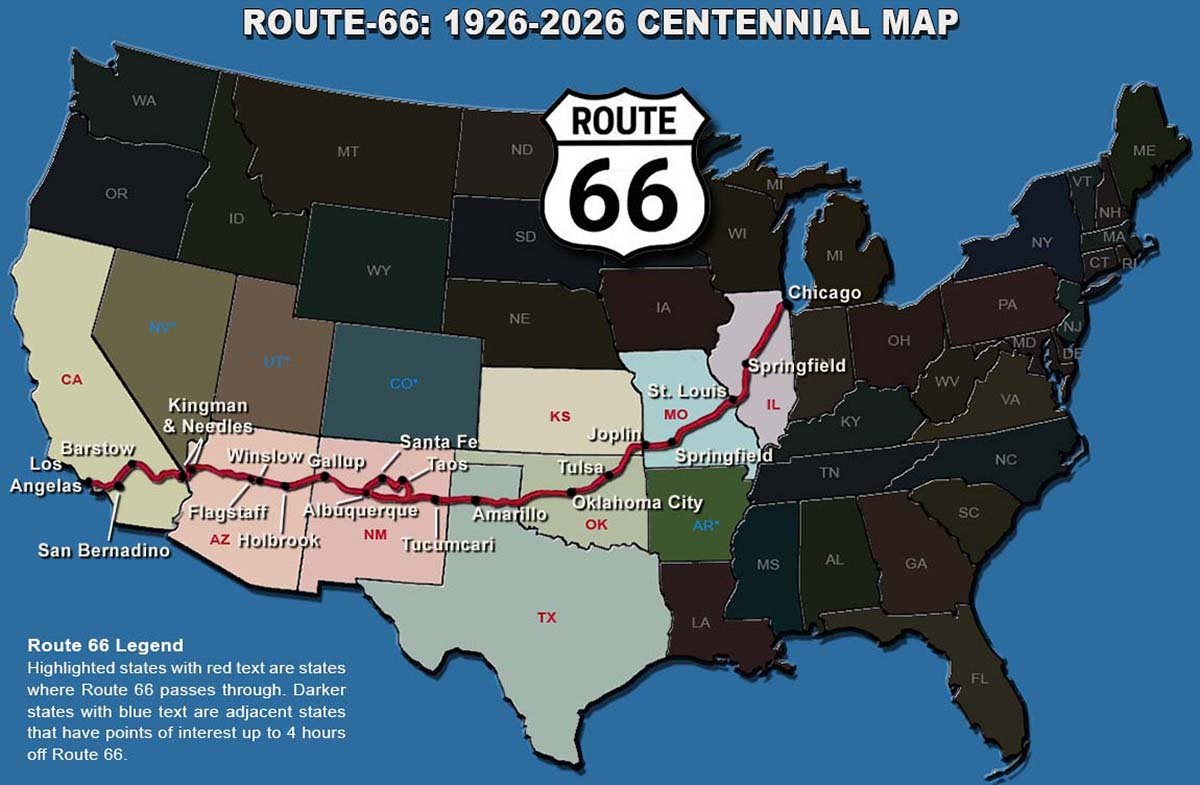
It all begins in 1926, when Route 66 was established as part of the new Numbered Highway System. The original route stretched a remarkable 2,448 miles, creating one continuous thread across the country at a time when the automobile was rapidly reshaping American life. The highway's famous alignment ran from Chicago, Illinois, to Santa Monica, California, cutting across Missouri, Kansas, Oklahoma, Texas, New Mexico, and Arizona along the way. For travelers and businesses alike, it offered a more direct path west: and its popularity rose quickly as Americans embraced the freedom of the open road.
Drive those miles today and you'll find an incredible range of experiences packed into a single journey. Major icons anchor the route: the Gateway Arch in St. Louis, the celebratory finish at the Santa Monica Pier, and dozens of historic main streets that still wear their Route 66 identity with pride. But the magic isn't only in the famous monuments. Route 66 also passes near natural wonders that feel almost unreal: including Arizona's massive Meteor Crater, formed roughly 50,000 years ago, a place that makes you feel the scale of deep time as sharply as you feel the scale of the desert.
And then there's the roadside Americana: the quirky, the offbeat, the irresistible "we have to stop for this" moments that make Route 66 a legend. If you're drawn to the unusual, you'll find no shortage of stops that turn a road trip into a scavenger hunt. One example: in San Bernardino, California, you can visit the original McDonald's site, now preserved as a museum: a small stop that opens a surprisingly big window into American pop culture.
Route 66 may cross eight states, but it was built to connect two bookend dreams: the industrial energy of Chicago and the sunlit promise of Southern California. In the 1920s, Route 66 was commissioned in part to create a faster, easier-to-follow way to travel between the Midwest and the West Coast, at a moment when car ownership was surging. The road's western reach became especially powerful during hard times, when families sought opportunity and a fresh start: turning Route 66 into a route of reinvention as much as transportation.
It also took more than geography to create this highway. Building Route 66 required advocacy, coordination, and vision: and one name rises above the rest: Cyrus Avery, often remembered as the "Father of Route 66." A Tulsa businessman with an extraordinary range of experience: teacher, entrepreneur, insurance agent, oilman: Avery played a central role in rallying support for the route during the formation of the federal highway network. Without champions like him, Route 66 might never have existed in the form we celebrate today.
Not long after the road opened, promoters found creative ways to turn it into a national headline. In 1928, Route 66 Association member Charles C. Pyle launched an attention-grabbing campaign: a transcontinental footrace from Los Angeles to New York City. The race covered roughly 3,400 miles and offered a huge $25,000 prize (nearly $400,000 in today's dollars). Nearly 300 runners took part, and the winner was Andy Payne, a Cherokee citizen, who finished in 573 hours. It was a bold, theatrical reminder that Route 66 wasn't merely a line on a map: it was an idea worth chasing.
That idea has echoed through American culture ever since. Writers and artists have used Route 66 as a stage for everything from hardship to hope. John Steinbeck helped cement its legend by calling it the "Mother Road" in The Grapes of Wrath, and other authors: including Jack Kerouac: wove the highway into stories about movement, freedom, and identity. Music followed naturally. Songwriter Bobby Troup wrote "(Get Your Kicks on) Route 66" during a road trip, and the tune became a major hit after the Nat King Cole Trio recorded it in 1946. It went on to be covered by artists across genres and generations, a musical proof that Route 66 belongs to everyone.
Of course, America's road network didn't stand still. In the 1950s, President Dwight D. Eisenhower pushed for a modern interstate system that would connect the country more efficiently. The Federal-Aid Highway Act of 1956 accelerated that transformation: and as new interstates replaced long stretches of the older route, Route 66 gradually lost its official role. In 1985, it was formally decommissioned. But the story didn't end there. Roughly 85% of the original alignment remains drivable today, with historic markers and preserved segments guiding travelers along the old path.
Route 66 still delivers surprises, too: including places that carry its name into the present. In Missouri, Route 66 State Park sits along the Meramec River at the site of the former town of Times Beach. Visitors come for scenery and trails, and many also seek out the old Route 66 bridge, a tangible piece of the road's working history that continues to be restored and remembered.
And here's one of the most delightful modern twists: in New Mexico, a short stretch of Route 66 can literally "play" music. To encourage drivers to maintain the 45 mph speed limit, the New Mexico Department of Transportation installed rumble strips at carefully spaced intervals. At the correct speed, your tires create the melody of "America the Beautiful." It's a clever bit of engineering: and a perfect Route 66 moment: practical, playful, and unforgettable.
Route 66 has always been bigger than asphalt. It's a moving museum, a memory machine, and a road where history and pop culture share the same lane. Whether you're planning a full journey or just sampling a few legendary miles, it's hard not to feel that pull: the sense that the road is still calling.


-cover-art-2.jpg)



-cover-art.jpg)

.jpg)